

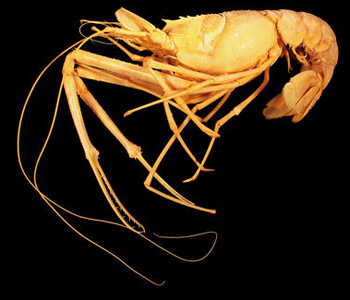
Phylum: Arthropoda Lar, 1904
Subphylum: CrustaceaBrünnich, 1772
Classe: Malacostraca Latreille, 1802
Ordine: Decapoda Latreille, 1802
Famiglia: Nephropidae Dana, 1852
Genere: Acanthacaris Bate, 1888
Español: Langosta del Atlántico
Descrizione
Si tratta di un gambero di mare di notevoli dimensioni, con una lunghezza totale massima di 40 cm (lunghezza della conchiglia da 2 a 17 cm). Il corpo è cilindrico, completamente ricoperto da piccole spine forti. Gli occhi sono molto piccoli e mancano di pigmento. Le antenne sono lunghe e a forma di frusta. Il cefalotorace ospita nella parte inferiore cinque paia di zampe, le tre paia precedenti terminano a tenaglie, la prima coppia è più grande con funzione difensiva e offensiva; La seconda coppia è più lunga della terza. Ha una coda potente e ben sviluppata che termina a forma di ventaglio.
Diffusione
Si trova nel Golfo del Messico, Mar dei Caraibi, Stretto della Florida. È una specie di acque profonde che vive tra i 293 e gli 878 m di profondità (per lo più tra i 550 e gli 825 m). Vive in tane costruite su fondali di fango soffice.
Sinonimi
= Neophoberus caecus (A. Milne-Edwards, 1881).
Bibliografia
–"Milne-Edwards, Alphonse (1881). "Description de Quelques Crustacés Macroures Provenant des Grandes Profondeurs de la Mer des Antilles". Annales des Sciences Naturelles (in French). 11 (6): 1-16.
–Felder, Darryl L.; Álvarez, Fernando; Goy, Joseph W.; Lemaitre, Rafael. "Decapoda (Crustacea) of the Gulf of Mexico, with Comments on the Amphionidacea". In Felder, Darryl L.; Camp, David K. (eds.). Gulf of Mexico Origin, Waters, and Biota (PDF). Vol. I, Biodiversity. pp. 1019-1104.
–Holthuis, Lipke B. (December 1974). "Biological Results of the University of Miami Deep-Sea Expeditions. 106. The Lobsters of the Superfamily Nephropidea of the Atlantic Ocean (Crustacea: Decapoda)". Bulletin of Marine Science. 24 (4): 723-884.
–Wahle, Richard A.; Tshudy, Dale; Cobb, J. Stanley; Factor, Jan; Mahima, Jaini (20 March 2012). "Infraorder Astacidea Latreille, 1802 p.p.: the marine clawed lobsters". In Schram, Frederick; von Vaupel Klein, Carel (eds.). The Crustacea. Treatise on Zoology - Anatomy, Taxonomy, Biology. Vol. 9B. Brill. pp. 59-60. The absence of eyes in the deepwater Acanthacaris caeca (A. Milne-Edwards, 1881) suggests either a more cryptic existence, or a greater dependence on the other sensory modes.
–Silva, K. C. A.; Cruz, R.; Cintra, I. H. A.; Abrunhosa, F. A. (January 2013). "Structure and diversity of the lobster community on the Amazon continental shelf". Crustaceana. 86 (9): 1084-1102.
–Briones-Fourzán, P.; Lozano-Álvarez, E.; Vázquez-Bader, A.R.; Gracia, A. (2020). "Deep-Sea Lobsters (Polychelidae and Nephropidae) from the Continental Slope of the Southern Gulf of Mexico: Distribution and Morphometric Relationships". In Hendrickx, Michel E. (ed.). Deep-Sea Pycnogonids and Crustaceans of the Americas. Springer Nature. pp. 311-341.
–Correa, Thiago B.S.; Eberli, Gregor P.; Grasmueck, Mark; Reed, John K.; Correa, Adrienne M.S. (October 2012). "Genesis and morphology of cold-water coral ridges in a unidirectional current regime". Marine Geology. 326-328: 14-27.
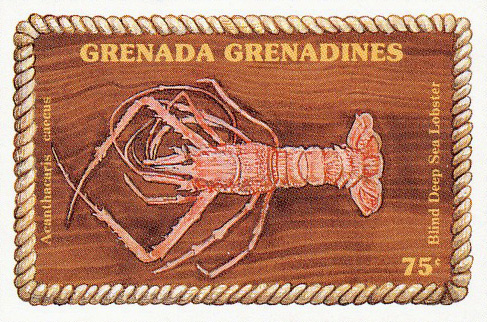
|
Data: 17/09/1990
Emissione: Crostacei Stato: Grenada and the Grenadines |
|---|